- Services
- Industries
- Accreditations & Recognitions
- Generators
- Company
- Tel: +49 9194 7262-0

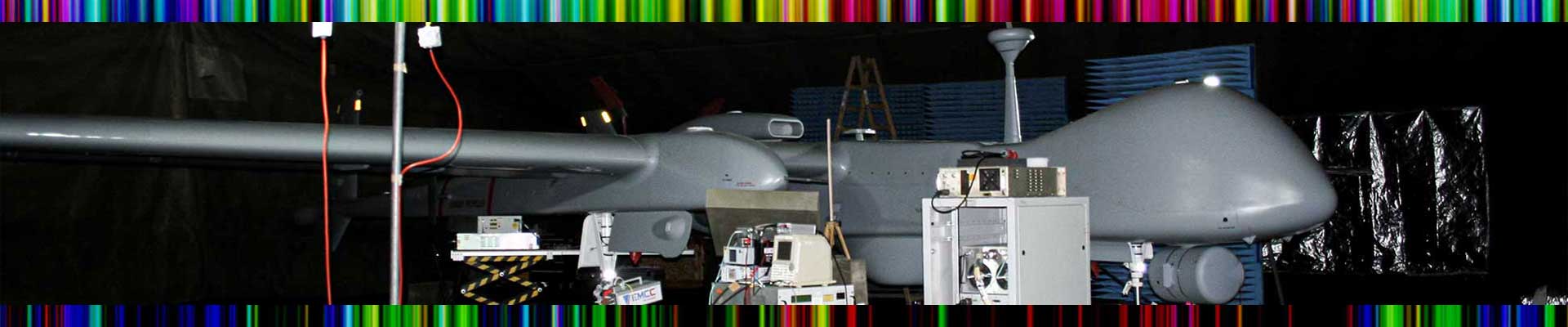
In sensitive military, aerospace, or defence applications, robust electromagnetic compatibility (EMC) testing is crucial. The MIL-STD-461 standard (commonly in its MIL-STD-461G version) prescribes requirements for electronic, electrical, or electromechanical equipment to ensure both emissions and susceptibility performance under electromagnetic stress conditions.
At EMCC DR. RAŠEK, we provide full-service EMC testing according all issues of MIL-STD-461 versions — whether in our shielded labs or via on-site testing worldwide.


The MIL-STD-461 standard establishes test procedures and limits for electromagnetic emissions (interference) and susceptibility of equipment and subsystems.
The latest edition is MIL-STD-461G (released in 2015).
It defines about 19 test methods, split into
• Emissions (conducted & radiated)
• Susceptibility (conducted & radiated)
• Special transient, lightning, ESD, etc.
Example test methods:
• CE101 / CE102 (conducted emissions)
• RE102 (radiated emissions)
• CS116 (transient on cables)
• RS103 (radiated susceptibility)
• CS117 (lightning transients), CS118 (ESD)
The standard allows tailoring, i.e. adapting test conditions based on the environment or customer requirement.
The purpose is to ensure that equipment can function reliably in electromagnetic environments, without interfering with other systems or being susceptible to external interference.
Dual Use: From Commercial Product to Defense Application
Companies that have previously produced exclusively for the civilian market can strategically adapt their systems for the defense industry and military applications. In the dual-use sector, testing according to MIL-STD-461 is an important step to reliably meet EMC requirements, military standards, and tender specifications, while unlocking new market opportunities in the defense sector.
Reliability & System Integration
In military, avionics, or safety-critical systems, electromagnetic compatibility is essential. A component that fails to meet limits can malfunction or disrupt adjacent systems — especially critical in mission environments.
Contractual & Qualification Requirement
Many defence procurement contracts mandate adherence to MIL standards. Demonstrated MIL-STD-461 compliance is often a prerequisite for acceptance.
Prevention of Failures & Cost Savings
Early tests identify design flaws and emission/susceptibility issues before costly redesigns or field failures occur.
Global Benchmark & Standardization
Though originating in the U.S., MIL-STD-461 is accepted globally in defence and aerospace sectors as a benchmark for EMC performance.
Avionics / Aerospace
Defence systems & ground stations
Communications, radar, control units
Drones / UAVs
Power supply systems in defence infrastructure
Mobile and transport platforms with stringent EMC requirements
Would you like to have your device tested according to MIL-STD-461 or receive early advice on EMC compliance? Contact us!
Feel free to take a look at other standards: